
eine Nachricht hinterlassen
Wenn Sie an unseren Produkten interessiert sind und mehr Details erfahren möchten, hinterlassen Sie bitte hier eine Nachricht. Wir werden Ihnen so schnell wie möglich antworten.



RFID vs. Barcode: Key Differences, Benefits, and How to Choose the Right Solution for Your Business
In today's increasingly competitive business environment, efficient inventory management, accurate product identification, and real-time data collection are essential for improving operational efficiency. Whether in warehousing, manufacturing, retail, logistics, or asset management, businesses need reliable identification technologies to track products, manage inventory, and maintain accurate records.
Two of the most widely used identification technologies are Radio Frequency Identification (RFID) and barcode systems. Both technologies help businesses identify and track items, but they operate in different ways and offer different advantages.
Barcode technology has been widely adopted because of its low implementation cost and simple operation. RFID, on the other hand, has gained popularity due to its ability to identify multiple items simultaneously, collect data without direct visual contact, and support automated tracking processes.
So, which technology is better for your business? Is RFID worth the investment, or is a traditional barcode system still sufficient? Understanding their differences, advantages, limitations, and applications can help businesses make the right decision.
Barcode technology uses printed patterns of lines, spaces, or geometric shapes to represent product information. Each barcode contains a unique identification number or data that can be read by a barcode scanner.
When a scanner captures the barcode, it converts the visual information into digital data and sends it to a connected computer or management system.
There are two common types of barcodes:
1D Barcodes: These consist of parallel lines and spaces with varying widths. Common examples include UPC and EAN codes, which are widely used in retail and product identification.
2D Barcodes: These include QR codes and Data Matrix codes. They can store more information than traditional 1D barcodes and are commonly used in product tracking, packaging, and digital identification.
Barcode systems are relatively easy to deploy. Businesses only need printed labels, barcode scanners, and compatible inventory management software. This makes them a practical choice for small businesses and operations with limited identification requirements.
However, barcode scanning generally requires a clear line of sight between the scanner and the barcode. Each item usually needs to be scanned individually, which can become time-consuming when handling large quantities of products.
RFID stands for Radio Frequency Identification. It is a wireless identification technology that uses radio waves to exchange information between RFID tags and readers.
An RFID system typically consists of three main components:
RFID Tags: Attached to products, packages, equipment, or other assets. Each tag contains a microchip and an antenna that stores and transmits identification information.
RFID Readers: Send and receive radio frequency signals to communicate with tags and collect their data.
RFID Software: Processes the collected information and connects it to inventory management, warehouse management, ERP, or other business systems.
RFID technology is generally divided into three frequency categories: LF (Low Frequency), HF (High Frequency), and UHF (Ultra-High Frequency).
Among them, UHF RFID is widely used in industrial applications because of its relatively long reading range, fast identification speed, and ability to read multiple tags simultaneously.
Unlike barcode systems, RFID does not require direct visual contact between the reader and the tag. Depending on the tag type, reader power, antenna configuration, and operating environment, RFID systems can identify items from several meters away.
This makes RFID particularly suitable for automated inventory counting, warehouse management, logistics tracking, and industrial asset management.
Although RFID and barcode technologies serve similar identification purposes, their operating principles create significant differences in practical applications.
|
Comparison |
RFID |
Barcode |
|---|---|---|
|
Identification method |
Radio frequency signals |
Optical scanning |
|
Line of sight |
Not required |
Required |
|
Reading distance |
From centimeters to several meters, depending on the system |
Usually close to the scanner |
|
Multiple-item reading |
Yes |
Generally one at a time |
|
Reading speed |
High-speed batch identification |
Depends on individual scanning |
|
Data storage |
Read/write capability on supported tags |
Usually fixed printed information |
|
Durability |
Available in rugged and industrial designs |
Labels may become damaged or unreadable |
|
Automation |
Highly suitable |
More dependent on manual operation |
|
Initial investment |
Generally higher |
Generally lower |
Reading Efficiency
One of the biggest differences between RFID and barcode technology is reading efficiency.
Barcode scanners typically need to locate and scan each label individually. In a warehouse, employees may need to scan hundreds or thousands of products during inventory counting.
RFID readers can identify multiple tags within their reading area simultaneously. For example, an RFID portal installed at a warehouse entrance can automatically identify tagged goods as they pass through, without requiring employees to scan every individual item.
Reading Distance
Barcode scanners usually need to be positioned close to the label, while RFID readers can identify tags from a distance.
For UHF RFID systems, the reading range can reach several meters under suitable conditions. This makes RFID useful for vehicle access management, warehouse inventory, and logistics operations.
Data Management
Traditional barcodes generally contain fixed identification information. When product details change, the associated information is usually updated in the database rather than on the printed label.
Some RFID tags support read/write functionality, allowing authorized users to update stored information directly on the tag. However, the actual storage capacity depends on the tag chip.
Environmental Adaptability
Barcode labels can become difficult to read when they are scratched, dirty, folded, or covered by other materials.
RFID tags are available in waterproof, heat-resistant, anti-metal, and industrial-grade designs. These options make RFID more suitable for challenging operating environments, although metal and liquids can affect radio frequency performance and must be considered during system design.
Neither technology is perfect for every business. Understanding their strengths and limitations is important before choosing an identification solution.
Low Initial Cost
Barcode labels are inexpensive, and barcode scanners are generally more affordable than RFID readers. This makes barcode systems attractive to small businesses and companies with limited budgets.
Simple Implementation
Barcode technology is mature and easy to understand. Most inventory management systems already support barcode identification, making integration relatively straightforward.
Wide Compatibility
Barcodes are widely used across retail, logistics, manufacturing, and healthcare. Their standardized formats make them easy to share across different systems and organizations.
Each item generally needs to be scanned individually.
Direct visual contact is required.
Labels can become unreadable due to physical damage.
Manual scanning increases labor requirements.
Real-time tracking and automated identification are more difficult to achieve.
1. Faster Inventory Management
RFID can read multiple tagged items simultaneously, significantly reducing the time required for stocktaking. Businesses can improve inventory accuracy while reducing repetitive manual work.
2. Automated Identification
RFID readers can be installed at warehouse entrances, production lines, loading areas, or access points. They automatically collect identification data when tagged items enter or leave designated areas.
3. Improved Data Accuracy
By reducing manual scanning and data entry, RFID helps minimize human errors. Businesses can obtain more consistent inventory information and improve supply chain visibility.
4. Flexible Identification
RFID tags come in different sizes and designs, including adhesive labels, hard tags, anti-metal tags, and waterproof tags. Businesses can select suitable tags according to their products and operating environments.
Higher initial investment in readers, antennas, tags, and software.
Radio frequency performance can be affected by metal, liquids, and surrounding materials.
System deployment requires professional configuration and testing.
Tag selection and antenna positioning require careful planning.
RFID is particularly valuable in industries where businesses handle large volumes of products, require frequent inventory updates, or need automated identification.
Warehouse and Logistics Management
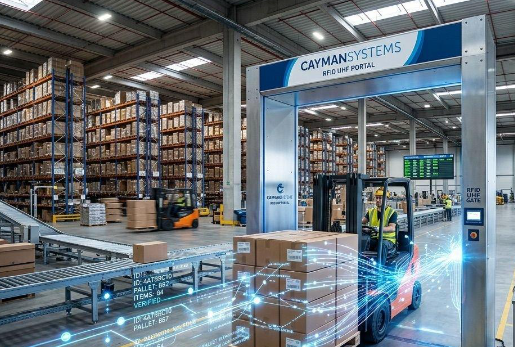
In warehouses, RFID can be used to track incoming and outgoing goods, monitor inventory levels, and improve picking and sorting efficiency.
UHF RFID readers and antennas can be installed at warehouse doors to identify tagged products automatically. Compared with traditional barcode scanning, this reduces manual operations and makes large-scale inventory management more efficient.
Manufacturing and Industrial Production
Manufacturers can attach RFID tags to raw materials, work-in-progress products, tools, and production equipment.
By installing RFID readers at different production stages, businesses can record product movement, monitor production progress, and improve material traceability.
Retail and Smart Inventory Management

Retail businesses can use RFID to manage clothing, footwear, electronics, and other products.
RFID handheld readers allow employees to conduct rapid shelf checks and inventory counts. RFID systems can also support smart fitting rooms, product tracking, and retail anti-theft applications.
Asset and Equipment Management
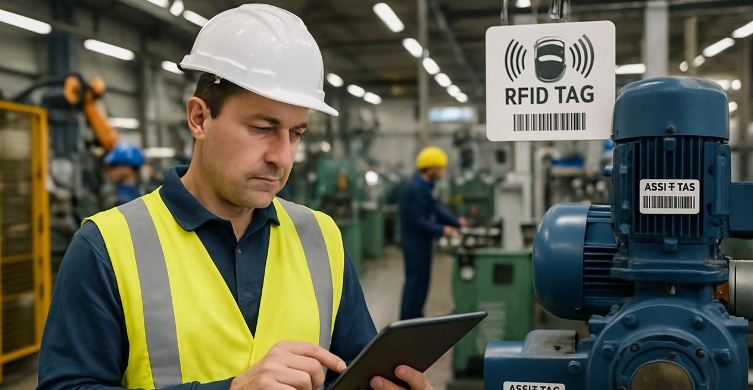
Hospitals, factories, construction companies, and other organizations often manage large numbers of valuable assets.
RFID tags can be attached to equipment and connected to centralized management systems. This helps organizations identify asset locations, monitor equipment movement, and reduce losses caused by misplaced items.
Cost is one of the most important considerations when choosing an identification technology.
Barcode systems generally require a smaller initial investment. For businesses with limited inventory volumes and relatively simple workflows, barcode technology may provide sufficient performance without unnecessary expenses.
RFID usually requires higher upfront investment, including tags, readers, antennas, software integration, and installation. However, its long-term value should be evaluated based on operational savings rather than equipment costs alone.
For example, consider a warehouse that needs to count 10,000 products regularly.
With a barcode system, employees may need to locate and scan each product individually. This requires considerable labor and time.
With an appropriately designed UHF RFID system, employees can use handheld readers or fixed RFID portals to identify multiple products simultaneously. Inventory counting becomes faster, and fewer employees may be needed for repetitive scanning tasks.
The return on investment (ROI) of an RFID system can come from several areas:
Reduced labor costs through automated inventory counting.
Lower inventory discrepancies and fewer stock-related losses.
Improved warehouse efficiency and product visibility.
Reduced time spent searching for misplaced assets.
Better accuracy in receiving, shipping, and material tracking.
However, RFID does not automatically guarantee a higher ROI. Businesses should evaluate tag costs, equipment investment, system integration, maintenance, and expected operational savings before implementation.
Choosing between RFID and barcode does not always mean selecting only one technology. In many businesses, the two systems can complement each other.
For example, a manufacturer may use barcode labels for product identification during manual production processes while using RFID tags to track products automatically between production areas.
A logistics company may use barcodes for parcel identification at individual workstations and RFID portals for automated shipment verification at warehouse entrances.
A combined system can provide flexibility while controlling implementation costs.
Businesses can also gradually introduce RFID technology. Instead of replacing every barcode system immediately, they can begin with high-volume inventory areas or processes where manual scanning creates the greatest operational challenges.
This approach allows companies to evaluate actual performance and expand RFID deployment based on measurable results.
Before investing in an identification system, businesses should consider several practical factors.
1. Inventory Volume
If your business handles a relatively small number of products, barcode technology may be sufficient. If you manage thousands of items and conduct frequent inventory checks, RFID may offer greater efficiency.
2. Operational Requirements
Consider whether your business needs individual product identification, batch reading, automated tracking, or real-time inventory updates. More complex identification requirements often favor RFID.
3. Operating Environment
Evaluate the materials, temperature, humidity, and physical conditions in your working environment. Metal surfaces and liquids may influence RFID performance, so appropriate tag and antenna selection is essential.
4. Budget and Long-Term Costs
Do not focus only on the initial equipment price. Consider labor costs, inventory errors, maintenance, system integration, and future expansion.
5. System Compatibility
Make sure the identification technology can integrate with your existing WMS, ERP, MES, or other management platforms.
A properly designed system should support your existing business processes while allowing future upgrades.
RFID and barcode technologies both play important roles in modern business operations. Barcode systems remain an economical and practical choice for businesses with straightforward identification requirements, while RFID offers significant advantages in automation, batch reading, inventory efficiency, and asset tracking.
For companies managing large inventories, complex supply chains, or high-value industrial assets, RFID can provide greater long-term operational value. UHF RFID readers, antennas, and tags make it possible to build flexible identification systems for warehouses, manufacturing facilities, retail stores, and logistics centers.
Ultimately, the best technology depends on your business scale, operational requirements, and investment objectives. In some cases, combining RFID and barcode technologies may be the most practical solution.
As businesses continue moving toward digitalization and intelligent management, RFID is becoming an increasingly important tool for improving visibility, reducing manual work, and building more efficient operations.

Detaillierte Informationen und PDF

Kontakt per E-Mail für Supportanfragen.

Professionelle technische Beratung.

Kontakt per E-Mail für Supportanfragen.



LINK

YouTube

eine Nachricht hinterlassen
Scannen Sie den QR-Code zu WeChat/WhatsApp :



 IPv6 NETZWERKUNTERSTÜTZT